Understanding the Problem
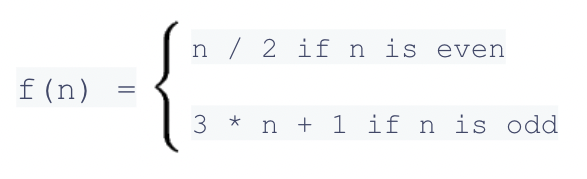
The core challenge of the Collatz Conjecture is to repeatedly apply a set of rules to transform a number until it reaches 1. This problem is significant in mathematics and computer science because it is simple to understand but has not been proven for all positive integers. Common applications include algorithm design and understanding iterative processes.
Potential pitfalls include not handling the even and odd conditions correctly or not stopping the loop when the number reaches 1.
Approach
To solve this problem, we need to repeatedly apply the transformation rules until the number becomes 1. A naive solution would involve a simple loop that checks if the number is even or odd and applies the corresponding transformation.
However, this naive approach is already optimal for this problem since each step reduces the number significantly, especially when the number is even.
Algorithm
1. Start with the given number n.
2. While n is greater than 1, do the following:
- If
nis even, divide it by 2. - If
nis odd, multiply it by 3 and add 1. - Print the current value of
n.
3. Stop when n becomes 1.
Code Implementation
/**
 * Function to print the Collatz sequence for a given number n
 * @param {number} n - The starting integer
 */
function collatzConjecture(n) {
  // Print the initial value of n
  console.log(n);

  // Continue the loop until n becomes 1
  while (n > 1) {
    if (n % 2 === 0) {
      // If n is even, divide it by 2
      n = n / 2;
    } else {
      // If n is odd, multiply by 3 and add 1
      n = 3 * n + 1;
    }
    // Print the current value of n
    console.log(n);
  }
}

// Example usage
collatzConjecture(3);
Complexity Analysis
The time complexity of this algorithm is O(log n) because, in the worst case, the number of steps required to reduce n to 1 is proportional to the logarithm of n. The space complexity is O(1) since we are using a constant amount of extra space.
Edge Cases
Potential edge cases include:
- n = 1: The sequence should immediately stop.
- n = 2: The sequence should be 2, 1.
- Large values of n: The algorithm should handle large values efficiently.
To test these edge cases, we can run the function with different values of n and verify the output.
Testing
To test the solution comprehensively, we can use a variety of test cases:
- Simple cases:
n = 1,n = 2 - Odd and even numbers:
n = 3,n = 4 - Large numbers:
n = 1000000
We can use JavaScript's built-in console for testing or frameworks like Jest for automated testing.
Thinking and Problem-Solving Tips
When approaching such problems, it is essential to:
- Understand the problem statement and constraints thoroughly.
- Break down the problem into smaller, manageable parts.
- Think about edge cases and how to handle them.
- Practice similar problems to improve problem-solving skills.
Conclusion
The Collatz Conjecture is a fascinating problem that is simple to understand but has deep mathematical implications. By understanding and solving this problem, we can improve our algorithmic thinking and problem-solving skills. Practice and exploration of similar problems can further enhance these skills.
