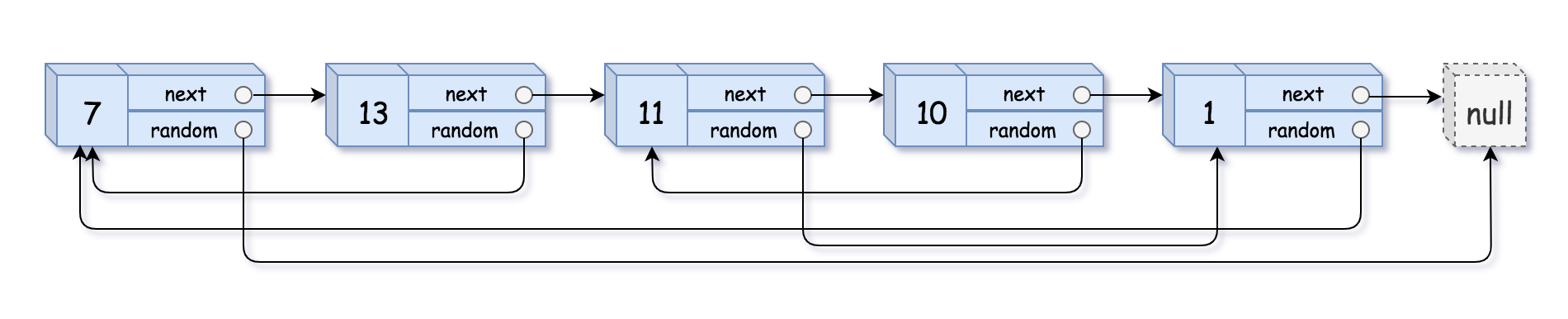


Understanding the Problem
The core challenge of this problem is to create a deep copy of a linked list where each node has an additional random pointer. The deep copy should be a completely new list with no shared references to the original list. This problem is significant in scenarios where data structures need to be duplicated without affecting the original structure, such as in undo operations, version control systems, or cloning complex objects.
Approach
To solve this problem, we can use a three-step approach:
- Interweaving the original list with copied nodes: Create new nodes and insert them right next to their corresponding original nodes. This helps in easily setting up the random pointers in the next step.
- Setting up the random pointers: Iterate through the interwoven list and set the random pointers for the copied nodes using the original nodes' random pointers.
- Separating the copied list from the original list: Extract the copied nodes to form the new deep copied list and restore the original list.
Algorithm
Let's break down the algorithm step-by-step:
- Iterate through the original list and create new nodes. Insert each new node right after its corresponding original node.
- Iterate through the interwoven list again to set the random pointers for the copied nodes.
- Separate the copied nodes to form the new list and restore the original list.
Code Implementation
// Definition for a Node.
function Node(val, next, random) {
    this.val = val;
    this.next = next;
    this.random = random;
}

/**
 * @param {Node} head
 * @return {Node}
 */
var copyRandomList = function(head) {
    if (!head) return null;

    // Step 1: Create new nodes and interweave them with the original nodes
    let current = head;
    while (current) {
        let newNode = new Node(current.val, current.next, null);
        current.next = newNode;
        current = newNode.next;
    }

    // Step 2: Set the random pointers for the new nodes
    current = head;
    while (current) {
        if (current.random) {
            current.next.random = current.random.next;
        }
        current = current.next.next;
    }

    // Step 3: Separate the new nodes to form the copied list
    current = head;
    let newHead = head.next;
    while (current) {
        let newNode = current.next;
        current.next = newNode.next;
        if (newNode.next) {
            newNode.next = newNode.next.next;
        }
        current = current.next;
    }

    return newHead;
};
Complexity Analysis
The time complexity of this algorithm is O(n) because we iterate through the list a constant number of times. The space complexity is also O(n) due to the space required for the new nodes.
Edge Cases
Consider the following edge cases:
- An empty list (head is null).
- A list with only one node where the random pointer is null or points to itself.
- A list where all random pointers are null.
These cases are handled by the algorithm as it checks for null pointers and correctly sets up the new list.
Testing
To test the solution comprehensively, consider the following test cases:
- Simple lists with a few nodes and various random pointer configurations.
- Edge cases as mentioned above.
- Large lists to ensure the algorithm handles the upper constraint efficiently.
Thinking and Problem-Solving Tips
When approaching such problems, consider breaking down the problem into smaller, manageable steps. Visualize the data structure and how the pointers need to be set up. Practice similar problems to improve your understanding of linked lists and deep copying techniques.
Conclusion
In this blog post, we discussed how to create a deep copy of a linked list with random pointers in O(n) time complexity using JavaScript. We covered the problem definition, approach, algorithm, code implementation, complexity analysis, edge cases, and testing. Understanding and solving such problems is crucial for mastering data structures and algorithms.
