

Understanding the Problem
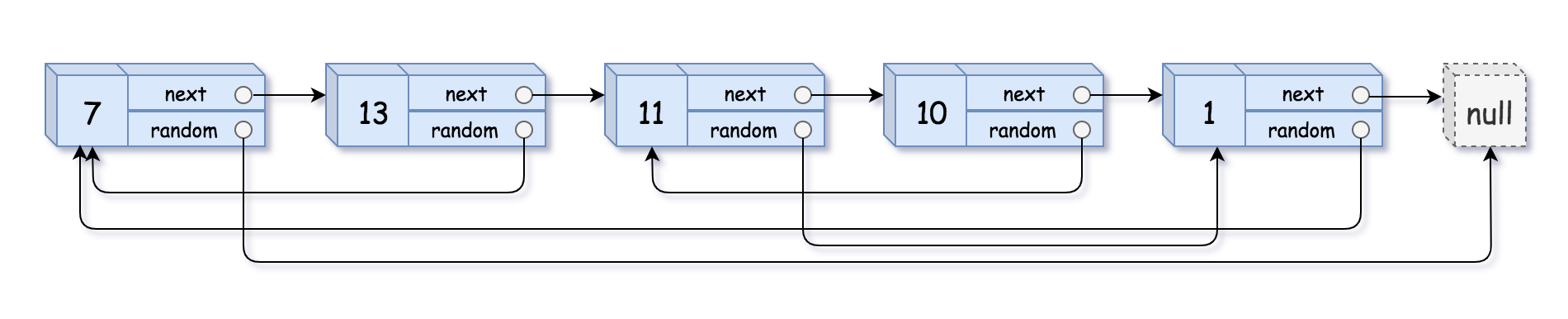
The core challenge of this problem is to create a deep copy of a linked list where each node has an additional random pointer. The deep copy should be a completely new list with no shared references to the original list. This problem is significant in scenarios where data integrity and isolation are crucial, such as in cloning complex data structures or undo mechanisms in applications.
Approach
To solve this problem, we can break it down into three main steps:
- Interweave the original list with copied nodes.
- Assign the random pointers for the copied nodes.
- Separate the interwoven list into the original and the copied list.
Step-by-Step Breakdown
1. Interweaving the Original List with Copied Nodes
We create a new node for each original node and insert it right after the original node. This way, the list will look like: original1 -> copy1 -> original2 -> copy2 -> ...
2. Assigning Random Pointers
For each original node, we set the random pointer of its copy to the copy of the original node's random pointer. This can be done by accessing the next node of the original node's random pointer.
3. Separating the Lists
Finally, we separate the interwoven list into the original list and the copied list by adjusting the next pointers accordingly.
Algorithm
// Definition for a Node.
function Node(val, next, random) {
    this.val = val;
    this.next = next;
    this.random = random;
}

function copyRandomList(head) {
    if (!head) return null;

    // Step 1: Interweave the original list with copied nodes
    let current = head;
    while (current) {
        const newNode = new Node(current.val, current.next, null);
        current.next = newNode;
        current = newNode.next;
    }

    // Step 2: Assign random pointers for the copied nodes
    current = head;
    while (current) {
        if (current.random) {
            current.next.random = current.random.next;
        }
        current = current.next.next;
    }

    // Step 3: Separate the interwoven list into original and copied lists
    current = head;
    const newHead = head.next;
    while (current) {
        const copy = current.next;
        current.next = copy.next;
        if (copy.next) {
            copy.next = copy.next.next;
        }
        current = current.next;
    }

    return newHead;
}
Complexity Analysis
The time complexity of this algorithm is O(n) because we traverse the list a constant number of times. The space complexity is O(1) extra space because we are not using any additional data structures that grow with the input size.
Edge Cases
- Empty list: The function should return
null. - Single node with a random pointer to itself.
- All random pointers are
null.
Testing
To test the solution comprehensively, consider the following test cases:
- Empty list
- Single node with no random pointer
- Single node with a random pointer to itself
- Multiple nodes with various random pointer configurations
Thinking and Problem-Solving Tips
When approaching such problems, it's essential to break down the problem into smaller, manageable steps. Visualizing the problem with diagrams can also help in understanding the relationships between nodes. Practice similar problems to improve your problem-solving skills.
Conclusion
In this blog post, we discussed how to create a deep copy of a linked list with random pointers in JavaScript. We broke down the problem into manageable steps, provided a detailed algorithm, and analyzed its complexity. Understanding and solving such problems is crucial for developing robust and efficient algorithms.
