

Understanding the Problem
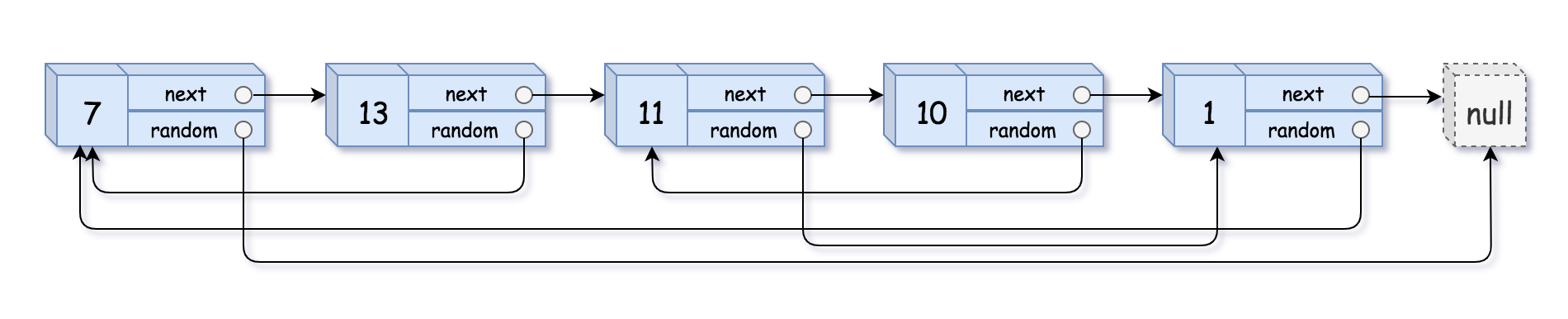
The core challenge of this problem is to create a deep copy of a linked list where each node has an additional random pointer. The deep copy should be a completely new list with no shared nodes with the original list. This problem is significant in scenarios where data integrity and isolation are crucial, such as in undo operations, cloning complex data structures, etc.
Approach
To solve this problem, we can use a three-step approach:
- Interweaving the original list with copied nodes: For each node in the original list, create a new node and insert it right after the original node.
- Assigning random pointers: Traverse the interwoven list and assign the random pointers for the copied nodes.
- Restoring the original list and extracting the copied list: Separate the interwoven list into the original list and the copied list.
Algorithm
Let's break down the algorithm step-by-step:
- Traverse the original list and create new nodes. Insert each new node right after its corresponding original node.
- Traverse the interwoven list and set the random pointers for the new nodes. If the original node's random pointer is not null, set the new node's random pointer to the new node corresponding to the original node's random pointer.
- Separate the interwoven list into the original list and the copied list. Restore the original list by skipping the new nodes and extract the copied list by skipping the original nodes.
Code Implementation
class Node:
    def __init__(self, val: int, next: 'Node' = None, random: 'Node' = None):
        self.val = val
        self.next = next
        self.random = random

def copyRandomList(head: 'Node') -> 'Node':
    if not head:
        return None

    # Step 1: Create new nodes and interweave them with the original nodes
    current = head
    while current:
        new_node = Node(current.val, current.next)
        current.next = new_node
        current = new_node.next

    # Step 2: Assign random pointers for the new nodes
    current = head
    while current:
        if current.random:
            current.next.random = current.random.next
        current = current.next.next

    # Step 3: Restore the original list and extract the copied list
    current = head
    new_head = head.next
    while current:
        new_node = current.next
        current.next = new_node.next
        if new_node.next:
            new_node.next = new_node.next.next
        current = current.next

    return new_head
Complexity Analysis
The time complexity of this algorithm is O(n) because we traverse the list a constant number of times. The space complexity is O(1) extra space because we are not using any additional data structures that grow with the input size.
Edge Cases
Consider the following edge cases:
- An empty list (head is null): The function should return null.
- A list with only one node: Ensure the random pointer is correctly assigned.
- Random pointers that point to null: Ensure these are correctly handled.
Testing
To test the solution comprehensively, consider the following test cases:
def print_list(head):
    result = []
    while head:
        random_index = None if not head.random else head.random.val
        result.append([head.val, random_index])
        head = head.next
    return result

# Test case 1
head = Node(7)
node1 = Node(13)
node2 = Node(11)
node3 = Node(10)
node4 = Node(1)
head.next = node1
node1.next = node2
node2.next = node3
node3.next = node4
node1.random = head
node2.random = node4
node3.random = node2
node4.random = head

copied_head = copyRandomList(head)
print(print_list(copied_head))  # Expected: [[7, None], [13, 7], [11, 1], [10, 11], [1, 7]]

# Test case 2
head = Node(1)
node1 = Node(2)
head.next = node1
head.random = node1
node1.random = node1

copied_head = copyRandomList(head)
print(print_list(copied_head))  # Expected: [[1, 2], [2, 2]]

# Test case 3
head = Node(3)
node1 = Node(3)
node2 = Node(3)
head.next = node1
node1.next = node2
node1.random = head

copied_head = copyRandomList(head)
print(print_list(copied_head))  # Expected: [[3, None], [3, 3], [3, None]]

# Test case 4
head = None
copied_head = copyRandomList(head)
print(print_list(copied_head))  # Expected: []
Thinking and Problem-Solving Tips
When approaching such problems, consider the following tips:
- Break down the problem into smaller, manageable steps.
- Think about edge cases and how to handle them.
- Write clean, readable code with comments to explain your thought process.
- Practice similar problems to improve your problem-solving skills.
Conclusion
In this blog post, we discussed how to solve the problem of copying a linked list with random pointers. We covered the problem definition, approach, algorithm, code implementation, complexity analysis, edge cases, and testing. Understanding and solving such problems is crucial for developing strong problem-solving skills and improving your coding abilities.
Additional Resources
For further reading and practice, consider the following resources:
