

Understanding the Problem
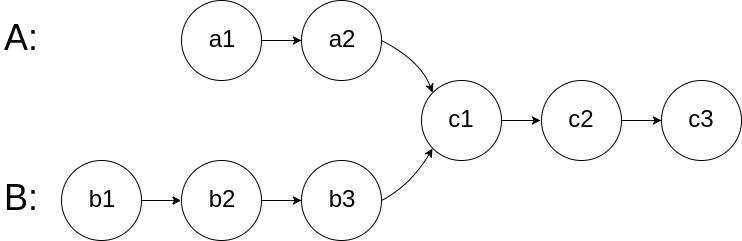
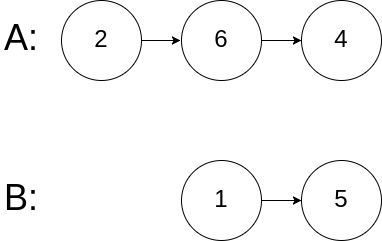
The core challenge of this problem is to identify the node at which two singly linked lists intersect. This is a common problem in linked list manipulation and has applications in various fields such as network routing, version control systems, and more. A potential pitfall is assuming that the lists intersect at the same position from the start, which is not necessarily true.
Approach
To solve this problem, we can use the following approaches:
Naive Approach
The naive approach involves using two nested loops to compare each node of the first list with each node of the second list. This approach has a time complexity of O(m * n), which is not optimal for large lists.
Optimized Approach
We can optimize the solution by using two pointers. The idea is to traverse both lists and switch to the other list once the end is reached. This way, both pointers will traverse the same number of nodes and meet at the intersection point if there is one.
Algorithm
Here is a step-by-step breakdown of the optimized algorithm:
- Initialize two pointers,
pAandpB, to the heads ofheadAandheadBrespectively. - Traverse the lists with the pointers. When a pointer reaches the end of a list, switch it to the head of the other list.
- If the lists intersect, the pointers will meet at the intersection node. If they do not intersect, both pointers will eventually be null.
Code Implementation
Here is the Python code for the optimized solution:
class ListNode:
    def __init__(self, x):
        self.val = x
        self.next = None

def getIntersectionNode(headA, headB):
    # Initialize two pointers
    pA, pB = headA, headB

    # Traverse the lists
    while pA != pB:
        # If pA reaches the end, switch to headB
        pA = pA.next if pA else headB
        # If pB reaches the end, switch to headA
        pB = pB.next if pB else headA

    # Either both pointers meet at the intersection node or both are null
    return pA
Complexity Analysis
The time complexity of this approach is O(m + n), where m and n are the lengths of the two linked lists. The space complexity is O(1) since we are using only two pointers.
Edge Cases
Potential edge cases include:
- One or both lists are empty.
- The lists do not intersect.
- The intersection occurs at the head of one or both lists.
These cases are handled by the algorithm as it ensures that both pointers traverse the same number of nodes.
Testing
To test the solution comprehensively, consider the following test cases:
- Lists with no intersection.
- Lists with intersection at various positions.
- Lists with different lengths.
Using a testing framework like unittest in Python can help automate and validate these test cases.
Thinking and Problem-Solving Tips
When approaching such problems, consider the following tips:
- Understand the problem requirements and constraints thoroughly.
- Think about different approaches and their trade-offs.
- Optimize for time and space complexity where possible.
- Practice solving similar problems to improve problem-solving skills.
Conclusion
In this blog post, we discussed the problem of finding the intersection of two linked lists. We explored a naive approach and an optimized approach using two pointers. The optimized solution runs in O(m + n) time and uses O(1) space. Understanding and solving such problems is crucial for improving algorithmic thinking and coding skills.
Additional Resources
For further reading and practice, consider the following resources:
