Problem overview
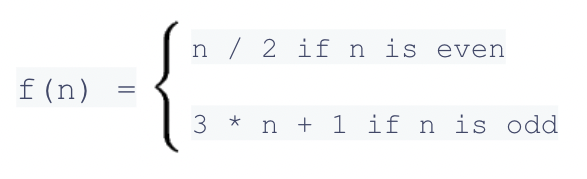
The function print_series takes an integer n and prints every value it takes while following the Collatz rules, one value per line, ending at 1. The rules are:
- if the current number is even, the next number is half of it;
- if the current number is odd, the next number is three times it plus one.
The function does not return anything. Its result is the printed output. For n = 3 it prints 3, 10, 5, 16, 8, 4, 2 and 1. The conjecture says that every positive starting value eventually reaches 1. Nobody has proved it, but the function only has to follow the sequence until it arrives there.
Approach
The same transformation is applied again and again, and the number of repetitions is not known in advance. That is the signature of a while loop: keep going as long as a condition holds. Here the condition is that the current value is greater than 1.
Inside the loop there are two cases, even and odd, so an if and else pick the right rule. After the number changes, the new value is printed. The starting value is printed once before the loop, because the series includes it.
For n = 6 the function prints 6, then 3 (6 is even), then 10 (3 is odd), then 5, 16, 8, 4, 2 and 1. The loop stops when the value is 1, so 1 is printed as the last term and nothing follows it.
Step by step
- Make a mutable copy of
n. Function parameters in Rust are immutable, sonumis declared withlet mutand starts asn. The loop can then changenumfreely. - Print the starting value. It is the first line of the output, and it must be printed even when the loop never runs.
- Open a
whileloop onnum > 1. The test is onnum, not onn. The loop changesnum, so a condition onnwould never change and the loop would never end. - Handle the even case. When
num % 2 == 0, divide it by 2. Division of twoi32values drops any remainder, but an even number divides exactly, so nothing is lost. - Handle the odd case. In the
elsebranch, setnumto3 * num + 1. - Print after the
if/else. Theprintln!sits at the end of the loop body, outside both branches, so it runs once for every new value whichever rule produced it.
The solution in Rust
impl Solution {
    fn print_series(n: i32) {
        let mut num = n;
        println!("{}", num);
        while num > 1 {
            if num % 2 == 0 {
                num /= 2;
            } else {
                num = 3 * num + 1;
            }
            println!("{}", num);
        }
    }
}
Some Rust details here:
println!is a macro. The!marks it as one. The{}in the format string is replaced by the value that follows, and each call ends the line.let mut. Bindings are immutable by default. Withoutmut, the linenum /= 2;is a compile error, because it assigns to a binding that cannot change.- No parentheses around conditions. Rust writes
while num > 1andif num % 2 == 0without them, but the braces are required. - The function returns
(). With no->in the signature and no final expression, it returns the empty tuple, which is Rust's "nothing". The lesson's tests look at what is printed. - Compound assignment.
num /= 2is shorthand fornum = num / 2.
Complexity
The number of steps depends on how long the sequence is, not on a simple formula in n. For n = 27 the series takes 111 steps and reaches 9232 along the way, although 27 is a small number.
Time: proportional to the length of the series, which is the number of loop iterations. Each iteration does constant work.
Space: O(1). Only n and num are stored, and the values are printed instead of collected.
Edge cases and common mistakes
n = 1. The function prints 1 and the loop is skipped, since 1 is not greater than 1.- Printing in the wrong place. If the
println!sits inside only one branch, half of the values are missing. If the first print is left out, the output starts one term late. - Testing
ninstead ofnum. The loop would either run forever or not at all. - Zero and negative inputs. The sequence is defined for positive integers. For
n = 0orn = -3, the function prints the number once and stops, because the loop condition is false from the start. - Overflow. An
i32holds values up to 2,147,483,647, and the odd rule can push a series past that. The series forn = 113383passes 2.4 billion. In an optimized build the value wraps to a negative number, the loop condition becomes false, and the printing stops early. In a debug build the same overflow panics. Ordinary test inputs stay far below this limit. - Using
=in the condition.num % 2 = 0does not compile. Comparison needs==.
Testing
n = 3prints 3, 10, 5, 16, 8, 4, 2, 1.n = 6prints 6, 3, 10, 5, 16, 8, 4, 2, 1.n = 1prints just 1.n = 2prints 2, then 1.
