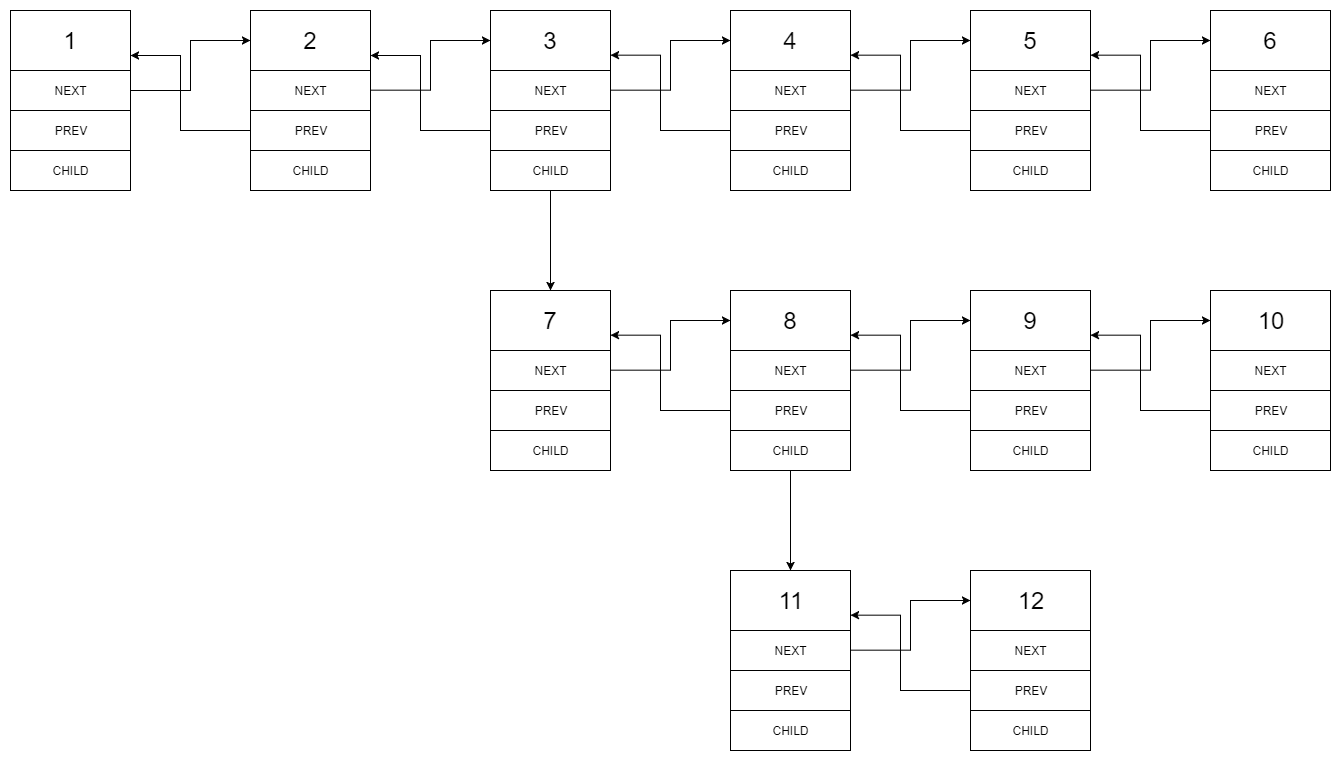
 After flattening the multilevel linked list it becomes:

Problem overview
A multilevel list is a linked list in which any node may also have a child: the head of another list, which can have children of its own. Flattening means producing one single-level order in which each node's child list comes right after the node and before the node's old next sibling.
In the lesson the structure is not made of pointers. It is a table adj, a slice of (i32, i32) pairs. Nodes are numbered from 1, and the node id doubles as its value. The entry adj[id] is the pair (next, child), and 0 means "no node", which is why ids start at 1. The function flatten(adj, head, result) pushes the flattened ids onto result.
The example has levels 1-2-3-4-5-6, 7-8-9-10 under node 3 and 11-12 under node 8. The flattened order is [1, 2, 3, 7, 8, 11, 12, 9, 10, 4, 5, 6]. For 1-2 with node 3 as the child of 1, the order is [1, 3, 2]. An empty list gives an empty result. The statement asks for a recursive solution that runs in O(n).
Approach: visit the node, then its child, then its next
The flattened order is a pre-order walk. For a node, first record it, then flatten everything below it through the child, and only then continue with its next sibling. The child's own children and siblings are handled by the same rule, so the problem repeats itself on a smaller structure. That is the shape of a recursive function:
- if the node is 0, there is nothing to do;
- push the node;
- recurse into its child;
- recurse into its next.
Doing the child before the next is the entire trick. When the child is flattened first, its whole sub-list lands between the node and the next sibling, which is where the problem wants it. Swapping the two calls would finish each level before descending, and the first example would come out as [1, 2, 3, 4, 5, 6, 7, 8, 9, 10, 11, 12].
Each node is visited exactly once, because every node is reachable by exactly one next or child entry. That gives O(n) time.
Step by step
- Declare the helper
flatten_levelnext toflatten. It takesadj: &[(i32, i32)](only read, so a shared slice is enough), the current idnode, andresult: &mut Vec<i32>. Because every recursive call receives the same mutable reference, they all append to one vector. - Guard the base case:
if node == 0. Id 0 marks a missing node, since real ids start at 1. - Return from that branch without touching
result. A function with no return type can end with a barereturn;. - Record the node:
result.push(node). Pushing before recursing is what makes the order pre-order. - Read the entry:
let (next, child) = adj[node as usize];. The slice is indexed with ausize, so thei32id is cast withas. The pair isCopy, so destructuring it copies two integers. - Recurse into
childfirst, so the sub-list is emitted right after the node. - Recurse into
next, which continues the current level after the sub-list. - Delegate from
flatten: it just callsSolution::flatten_level(adj, head, result).
The solution in Rust
struct Solution;

impl Solution {
    fn flatten_level(adj: &[(i32, i32)], node: i32, result: &mut Vec<i32>) {
        if node == 0 {
            return;
        }
        result.push(node);
        let (next, child) = adj[node as usize];
        Solution::flatten_level(adj, child, result);
        Solution::flatten_level(adj, next, result);
    }

    fn flatten(adj: &[(i32, i32)], head: i32, result: &mut Vec<i32>) {
        Solution::flatten_level(adj, head, result);
    }
}
Rust details worth knowing:
- Calling an associated function. Neither function takes
self, so they are called through the type:Solution::flatten_level(...). Inside theimplblock,Self::flatten_level(...)would mean the same. - Passing a
&mutdown. Passingresultto a callee reborrows it for the duration of the call, so the same variable can be passed again on the next line. Nocloneand no explicit reborrow is needed. - The cast
as usize. A negative id would wrap to a huge index and the indexing would panic. Valid ids are positive, and 0 is handled before the index is used. - Index out of bounds panics. The table needs an entry for every id that can occur, including index 0 for the unused slot, so for ids 1 to 12 the slice has at least 13 entries.
- The table, not the nodes, is borrowed. There is no ownership puzzle here, which is why the recursion is so short compared with a version built on
Boxpointers.
Complexity
Time: O(n). Every node is pushed once and does a constant amount of work. Calls on the id 0 also cost a constant amount, and there are at most two of them per node.
Space: O(n) in the worst case. The result holds n ids. On top of that, the call stack grows with the nesting depth of the structure: a chain in which every node is the child of the previous one makes the recursion as deep as the list is long. A chain of 200,000 such nodes overflows the stack and aborts the program. The lesson's iterative version avoids that by keeping its own stack in a vector on the heap.
Edge cases and common mistakes
- Empty list.
head = 0hits the base case at once, andresultstays empty. - No children. A plain list
1-2-3comes out as[1, 2, 3]. - Next before child. The output would then keep every level separate, and example 2 would give
[1, 2, 3]instead of[1, 3, 2]. - Pushing after the recursion. That gives a post-order: children before their parent.
- Forgetting the base case. Without the check on 0, the code would read
adj[0]and push 0 into the result, and the recursion would never stop, since the entry at index 0 is(0, 0). - Using an id as the table size. The table needs
max_id + 1entries, because index 0 is unused.
Testing
- The three-level example, with
adj[3] = (4, 7),adj[8] = (9, 11)and the plain next links elsewhere, gives[1, 2, 3, 7, 8, 11, 12, 9, 10, 4, 5, 6]. - Node 1 with next 2 and child 3 gives
[1, 3, 2]. - The head 0 gives
[].
