Problem overview
The function largest_rectangle_area receives a vector heights. Each value is the height of one histogram bar, and every bar is 1 unit wide. The function returns the area of the largest rectangle that fits inside the histogram, with its sides along the bars and the axis.
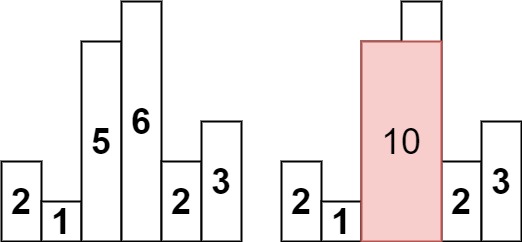
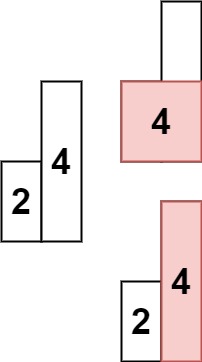
For heights = [2, 1, 5, 6, 2, 3] the answer is 10: the bars of heights 5 and 6 are next to each other, and a rectangle of height 5 and width 2 has area 10. For [2, 4] the answer is 4, either the single bar of height 4 or the two bars together at height 2. The heights are between 0 and 10,000 and there can be up to 100,000 bars, so the answer is at most 1,000,000,000. That fits in an i32.
Approach: the lowest bar decides the height
Any rectangle in a histogram is limited by its shortest bar. So every candidate can be described by that shortest bar i: the rectangle has height heights[i] and stretches left and right for as long as the neighbouring bars are at least as tall. Trying every bar as the shortest one covers every possible best rectangle.
The brute-force version walks left and right from each bar to find how far it can stretch, which costs O(n) per bar and O(n²) overall. That is too slow for 100,000 bars. The faster idea finds both boundaries for all bars in linear time:
left[i]is the index of the nearest bar to the left ofithat is lower thanheights[i], or-1if there is none.right[i]is the index of the nearest lower bar to the right, ornif there is none.
The widest rectangle of height heights[i] covers the indices strictly between those two bars, so its width is right[i] - left[i] - 1 and its area is heights[i] * (right[i] - left[i] - 1).
Finding the nearest lower bar uses a stack of indices whose heights never decrease from bottom to top. A bar waits on the stack until a lower bar arrives. When bar i is lower than the bar on top, then i is the first lower bar that index has met, so its boundary is settled and it can be removed. Bars that were already on the stack and are taller get settled the same way, one after another, until the top is no taller than bar i. Then i joins the stack.
For [2, 1, 5, 6, 2, 3] the two passes give:
left  = [-1, -1, 1, 2, 1, 4]
right = [ 1,  6, 4, 4, 6, 6]
The areas are then 2, 6, 10, 6, 8 and 3, and the maximum is 10, from the bar of height 5 (indices 2 and 3 are inside its boundaries 1 and 4).
Step by step
- Store the length as
n. It is used for the loops and as the "no lower bar" marker. - Create
leftas a mutable vector ofnvalues, all-1. The default means that no lower bar was found, as if a bar of height 0 stood just before the start. - Create
rightthe same way, filled withn as i32, as if a zero-height bar stood just after the end. - Create the stack
stas an emptyVec<usize>. It stores indices, so the element type is the one used for indexing. - Scan left to right and call the helper
remove_and_updatewithright. When bariarrives, every taller bar on the stack has found its nearest lower bar on the right. - Clear the stack. Whatever is still there has no lower bar to its right, and
rightalready holdsnfor those. The second pass needs a fresh stack. - Scan right to left with
(0..n).rev()and call the same helper withleft. Going in the opposite direction, the first lower bar that an index meets is its nearest lower bar on the left. - Take the best area. Keep a running
answerstarting at 0, and for every bar compare it with the area computed fromleftandright. - Return
answeras the last expression. - The helper pops while the stack is not empty and the current bar is strictly lower than the bar whose index is on top. Each popped index gets
istored inarr. Then it pushesi.
The solution in Rust
impl Solution {
    fn remove_and_update(heights: &[i32], st: &mut Vec<usize>, arr: &mut Vec<i32>, i: usize) {
        while !st.is_empty() && heights[i] < heights[*st.last().unwrap()] {
            let top = st.pop().unwrap();
            arr[top] = i as i32;
        }
        st.push(i);
    }

    fn largest_rectangle_area(heights: Vec<i32>) -> i32 {
        let n = heights.len();
        let mut left = vec![-1i32; n];
        let mut right = vec![n as i32; n];
        let mut st: Vec<usize> = Vec::new();

        for i in 0..n {
            Self::remove_and_update(&heights, &mut st, &mut right, i);
        }

        st.clear();
        for i in (0..n).rev() {
            Self::remove_and_update(&heights, &mut st, &mut left, i);
        }

        let mut answer = 0i32;
        for i in 0..n {
            answer = answer.max(heights[i] * (right[i] - left[i] - 1));
        }
        answer
    }
}
Rust details worth a closer look:
- Borrowing into the helper.
&heightslends the vector read-only. The parameter type is the slice&[i32], and Rust converts&Vec<i32>to it automatically.&mut stand&mut rightlet the helper change the caller's vectors without taking ownership of them. *st.last().unwrap().last()returns anOption<&usize>. Theunwrap()is safe because!st.is_empty()is checked first, and&&stops evaluating as soon as that check fails. The*reads the index out of the reference so it can indexheights.- Mixing
usizeandi32. Indices areusize, butleftandrightholdi32values so that-1is possible, and so thatheights[i] * (right[i] - left[i] - 1)is plaini32arithmetic. The conversions aren as i32andi as i32. (0..n).rev(). A loop counting down over ausizewould have to stop at 0 without going to -1, which ausizecan't hold. Reversing a range avoids the problem.- Final expression.
answerhas no semicolon, so it is the return value.answer.max(...)is themaxmethod ofi32, which returns the larger of the two values.
Complexity
Time: O(n). In each pass, every index is pushed once and popped at most once, so the while loops do at most n pops in total across the pass, even though a single call can pop many bars. Together with the final loop, that is about three linear passes.
Space: O(n). The vectors left and right hold n values each, and the stack holds up to n indices.
Edge cases and common mistakes
- Equal heights. The helper pops only strictly taller bars. For
[3, 3, 3]nothing is ever popped, so every bar gets the boundaries-1and3, a width of 3, and the answer is 9. If the condition were<=, each bar would stop at its equal neighbour, and the same input would return 3. - A single bar or zeros.
[5]gives 5 and[0, 0, 0]gives 0. A zero-height bar produces area 0, andanswerstarts at 0. - Sorted heights.
[1, 2, 3, 4, 5]and[5, 4, 3, 2, 1]both give 9 (height 3 over three bars). In the increasing case nothing is popped in the left-to-right pass; in the right-to-left pass every new bar pops the one before it. - A dip in the middle.
[2, 1, 2]gives 3: the bar of height 1 stretches over the whole histogram, which beats a single bar of height 2. - Forgetting
clear(). Leftover indices from the first pass would be compared against the second pass, and they could overwrite correct values inleft. - Overflow. The largest possible area is 100,000 × 10,000 = 1,000,000,000, below the
i32limit of about 2.1 billion. The lessons build with optimizations, where an overflow would wrap silently, so a wider type matters only if the limits grow.
Testing
[2, 1, 5, 6, 2, 3]gives 10.[2, 4]gives 4.[3, 3, 3]gives 9.[2, 1, 2]gives 3.[0]gives 0.
