Problem overview
The function solve_n_queens receives an i32, n (from 1 to 9), and must place n queens on an n by n chessboard so that no two attack each other. Queens attack along their row, their column and both diagonals. The function returns every distinct solution, in any order.
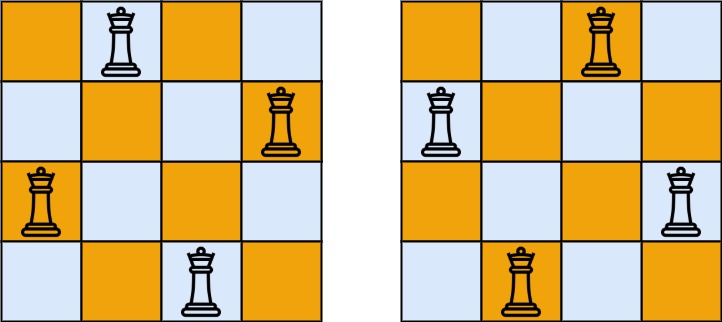
A solution is written as a vector of n numbers: entry r is the column of the queen in row r. For n = 4 there are two solutions, [1, 3, 0, 2] and [2, 0, 3, 1]. In the first, the queens sit at row 0 column 1, row 1 column 3, row 2 column 0 and row 3 column 2.
Approach: place one queen per row and undo bad choices
Every row must contain exactly one queen, since two queens in a row would attack each other and n queens must fit in n rows. So the search can go row by row, and for each row only the column is a choice. That cuts the search space from every placement on the board to at most n^n sequences of columns.
The technique is backtracking:
- For the current row, try each column in turn.
- If a queen at that square is attacked by one placed earlier, skip the column.
- Otherwise place the queen, move on to the next row, and when that call comes back, remove the queen so the next column can be tried.
- When the current row equals
n, every row has a queen. Save a copy of the placement as a solution.
Checking a square only needs the earlier rows. A queen at (row, col) conflicts with one at (i, placement[i]) if they share a column, or if they are on the same diagonal. Two squares are on a diagonal when the row distance equals the column distance, in absolute value. The rows are different by construction, so that case needs no check.
The pruning is what makes the search small. In the 4-queens puzzle, a queen at row 0 column 0 leaves columns 2 and 3 for row 1 (column 0 shares the column and column 1 shares the diagonal). If row 1 takes column 2, every column of row 2 is attacked, so that branch is abandoned after a few steps.
Step by step
- In
solve_n_queens, createplacements, a mutableVec::new()that will hold every solution. - Create
placementthe same way: the columns chosen so far. - Start the search with
Self::backtrack(n, 0, &mut placement, &mut placements), from row 0, and returnplacementsas the final expression. - Declare
backtrackwithn: i32,row: usize(it indexesplacement), and both vectors as mutable references so that changes are visible across calls. - Base case. If
row == n as usize, pushplacement.clone()intoplacementsand return. The copy is a snapshot: the original keeps changing as the search continues. The cast is needed because Rust won't compare ausizewith ani32. - Loop over the columns,
for col in 0..n. Sincenis ani32,colis one too, matching the type stored inplacement. - Test the square with
Self::is_valid(placement, row, col). - Choose, explore, undo. Inside the
if,placement.push(col), thenSelf::backtrack(n, row + 1, placement, placements), thenplacement.pop(). - Write
is_validwith the signature(placement: &[i32], row: usize, col: i32) -> bool. Loopiover0..rowand returnfalseifplacement[i] == col(same column) or the row distance equals the column distance. Cast bothrowanditoi32before subtracting, and compare with.abs(). - If no conflict is found, the loop ends and
trueis the final expression.
The solution in Rust
impl Solution {
    fn is_valid(placement: &[i32], row: usize, col: i32) -> bool {
        for i in 0..row {
            if placement[i] == col || (row as i32 - i as i32).abs() == (col - placement[i]).abs() {
                return false;
            }
        }
        true
    }

    fn backtrack(n: i32, row: usize, placement: &mut Vec<i32>, placements: &mut Vec<Vec<i32>>) {
        if row == n as usize {
            placements.push(placement.clone());
            return;
        }
        for col in 0..n {
            if Self::is_valid(placement, row, col) {
                placement.push(col);
                Self::backtrack(n, row + 1, placement, placements);
                placement.pop();
            }
        }
    }

    fn solve_n_queens(n: i32) -> Vec<Vec<i32>> {
        let mut placements = Vec::new();
        let mut placement = Vec::new();
        Self::backtrack(n, 0, &mut placement, &mut placements);
        placements
    }
}
The Rust details worth a closer look:
- Type inference for the empty vectors.
Vec::new()doesn't say what it holds. The compiler works it out from how the vectors are used:placementsis returned as aVec<Vec<i32>>andplacementis passed where a&mut Vec<i32>is expected. - Passing
&mutdown. Insolve_n_queensthe vectors are owned, so the call uses&mut placement. Insidebacktrackthey are already mutable references, and they are passed to the next call as they are. Rust lends them for the call and takes them back afterwards. - A
&mut Vec<i32>where a&[i32]is expected.is_validonly reads, so it takes a slice. Passingplacementconverts it automatically into a read-only slice, and the call compiles without any extra syntax. clone()makes a snapshot. Pushingplacementitself isn't possible, because it is a borrowed reference that keeps changing.clone()copies the numbers into a new vector, so laterpushandpopcalls don't affect the saved solution.pop()returns anOption. The returned value is ignored here, which the compiler allows. The vector is never empty at that point, since the push just before it added an element.- Signed arithmetic for the diagonal test.
rowandiareusize, soi - rowwould underflow, androw - iis fine only becausei < row. The code casts both toi32first, so the difference is a plain signed number and.abs()applies. for i in 0..row. The range excludesrow, so it covers exactly the rows already filled. For row 0 it is empty and the square is always valid.
Complexity
Time: exponential, with heavy pruning. Without pruning there would be n^n column sequences. The validity check cuts most branches early. Each call tests up to n columns, each test costing O(n). The number of solutions itself grows quickly: 1, 0, 0, 2, 10, 4, 40, 92 and 352 for n from 1 to 9. That is why the input is limited to 9.
Space: O(n) besides the output. The recursion is n calls deep, and placement holds at most n numbers. The output holds all the solutions, each of length n.
Edge cases and common mistakes
n = 1. One queen on a 1x1 board: the result is[[0]].n = 2andn = 3. No arrangement exists. The result is an empty vector,[].- Forgetting
pop(). The undo step is what makes the search try other columns. Without it, the leftover queens make most squares look attacked and solutions are missed. - Checking only the column. Without the diagonal test, the search would return permutations of the columns, many of them invalid.
- Diagonal test with a signed difference. Comparing
row - iwithcol - placement[i]without.abs()catches only one of the two diagonal directions. - Order of results. Trying columns from 0 upward gives the solutions in sorted order, for example
[[1, 3, 0, 2], [2, 0, 3, 1]]forn = 4. Any order is accepted.
Testing
n = 1gives[[0]].n = 2gives[].n = 4gives[[1, 3, 0, 2], [2, 0, 3, 1]].n = 5gives 10 solutions, the first being[0, 2, 4, 1, 3].n = 8gives 92 solutions.
