Problem overview
The method flatten receives the root of a binary tree and rewires it in place into a "linked list" made of the same TreeNode objects. In the result, every node's right pointer leads to the next node of the list, and every left pointer is null. The list must follow the preorder of the original tree: a node, then its left subtree, then its right subtree.
The method returns Unit, so it has no result to hand back. The caller's root is the head of the list afterwards.
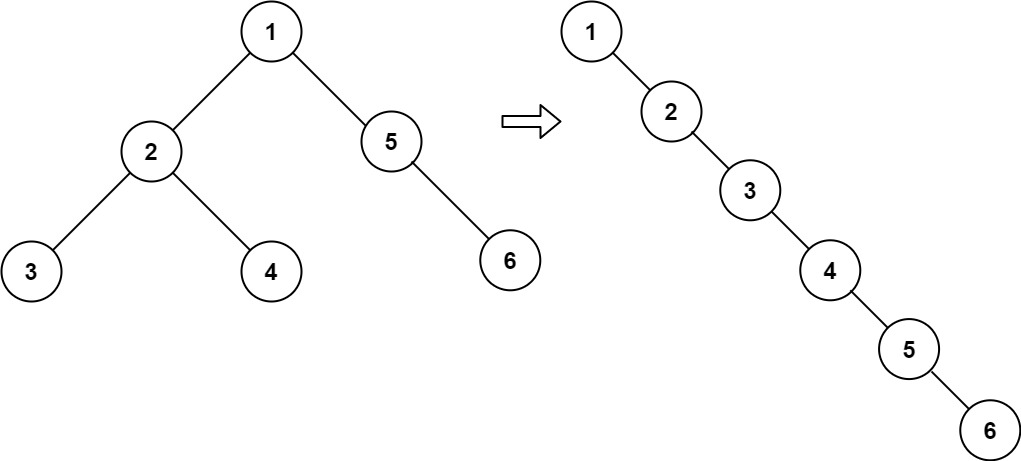
In the first example, the tree has root 1, children 2 and 5, node 2 has children 3 and 4, and node 5 has a right child 6. Its preorder is 1, 2, 3, 4, 5, 6, so after flattening, the root 1 leads through its right pointers to 2, 3, 4, 5 and 6, and no node has a left child. An empty tree stays empty, and a single node stays as it is.
Approach: build the list from the back
The natural plan is to link each node to its successor in preorder. The difficulty is that, when you stand at a node, its successor is the head of the left subtree's list, and the end of that list must then connect to the right subtree. Finding that end takes extra work.
The lesson avoids the problem by visiting the nodes in the reverse of preorder: right subtree, then left subtree, then the node. In that order, the node visited just before the current one is always the node that must follow it in the list. So one field, lastNode, is enough. It holds the head of the list built so far.
When the walk is at a node and has finished both subtrees, lastNode is the head of the list for the left subtree, which ends by leading into the right subtree's list, which in turn leads into everything that comes later in preorder. That is exactly what should follow the current node. So the node points its right at lastNode, clears its left, and becomes the new lastNode.
On the first example, the nodes are processed in the order 6, 5, 4, 3, 2, 1. Node 6 points to null, 5 points to 6, 4 points to 5, 3 points to 4, 2 points to 3, and finally 1 points to 2. The list reads 1, 2, 3, 4, 5, 6, which matches the preorder.
Step by step
- Declare
lastNodeas avarof typeTreeNodein the class, starting atnull. As a field, it is shared by every recursive call ofdfs. - Reset it in
flatten. A field keeps its value between calls, so the sameSolutionobject used for a second tree would otherwise start with a leftover node from the first. - Call
dfs(root), a helper that flattens a whole subtree. It is written next, and a method of a class can call another method wherever it is placed. - Declare
dfswith aTreeNodeparameter and the return typeUnit, since it rewires nodes instead of returning anything. - Handle the base case. When
rootisnull, return. - Recurse on the right subtree first. After this call, the right side is flattened and
lastNodeis its head. - Recurse on the left subtree. After this call, the left side is flattened and its list ends by leading into the right list, and
lastNodeis the head of the left list. - Point
root.rightatlastNode. The node now links straight into the list built so far. - Clear
root.left. The left subtree is already reachable throughrightpointers, so nothing is lost. - Record
rootinlastNode. The node is the new head of the list, and the node processed next will link to it.
The solution in Scala
class Solution {
    def dfs(root: TreeNode): Unit = {
        if (root == null) {
            return
        }
        dfs(root.right)
        dfs(root.left)
        root.right = lastNode
        root.left = null
        lastNode = root
    }

    var lastNode: TreeNode = null
    def flatten(root: TreeNode): Unit = {
        lastNode = null
        dfs(root)
    }
}
The Scala details worth a closer look:
- A
varin the class body is a field.var lastNode: TreeNode = nullbelongs to eachSolutionobject, and every method reads and writes the same variable. The order of members in a class doesn't matter, sodfscan uselastNodealthough it is declared below it. - The type is spelled out. Writing only
= nullwould make Scala infer the typeNull, which can't hold a node. The annotation: TreeNodegives the variable the type it needs. - The node's pointers are assignable.
root.right = lastNodeandroot.left = nullwork because this lesson'sTreeNodedeclaresleftandrightasvarfields. - Unit means in place.
flattenreturns nothing, so the work is visible only through the nodes the caller already holds. returnfor the early exit. In a method returningUnit, a barereturnleaves the method at once. It is the simplest way to write thenullbase case.
Complexity
Time: O(n) for n nodes. Each node is processed once, with a constant amount of work for its three assignments, plus one extra call for each missing child.
Space: O(h) for the call stack, where h is the height of the tree, and O(1) for everything else. The nodes are reused and no new ones are created. A tree that is one long chain has height n, so the stack use can reach O(n) in the worst case.
Edge cases and common mistakes
- Empty tree. A
nullroot makesdfsreturn at once, andflattenchanges nothing. - Single node. The node's
rightis set tonull(the reset value oflastNode), and itsleftstaysnull. - Only a left child. Root 7 with left child 8 becomes 7, then 8 on the right. The left pointer of 7 is cleared.
- Left child that has a right child. Root 1 with right child 2 whose left child is 3 becomes 1, 2, 3, because 3 is the left subtree of 2 and comes before whatever follows.
- Recursing left before right. That would link each node to the wrong successor and produce a different order than preorder.
- Forgetting
root.left = null. The list would still have the right order throughright, but nodes would keep their old left children and the result wouldn't be a list. - Forgetting to reset
lastNode. On a second call with the sameSolutionobject, the last node of the new tree would point into the old list.
Testing
- Root 1 with left child 2 (children 3 and 4) and right child 5 (right child 6) becomes 1, 2, 3, 4, 5, 6 on the right pointers.
- A
nullroot stays empty. - The single node 0 stays 0.
- Root 7 with left child 8 becomes 7, 8.
- Root 1 with right child 2, which has a left child 3, becomes 1, 2, 3.
