Problem overview
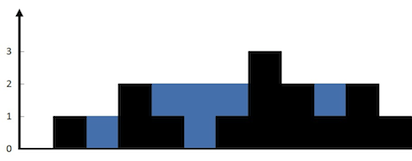
The method trap receives height, an Array[Int] that describes an elevation map: each element is the height of a bar of width 1. After rain, water collects in the dips between taller bars. The method returns the total amount of water that stays, as an Int.
For [4, 2, 0, 3, 2, 5] the answer is 9. The bar of height 4 on the left and the bar of height 5 on the right form walls. Between them, the water level is limited by the lower wall, 4, so the column over the bar of height 2 holds 2 units, the column over 0 holds 4, over 3 holds 1, and over the next 2 holds 2. That adds up to 9. For [0, 1, 0, 2, 1, 0, 1, 3, 2, 1, 2, 1] the answer is 6.
There are between 1 and 30,000 bars, each between 0 and 10,000 high.
Approach: water over each bar, from the walls around it
Think about one bar at a time. Water above bar i can rise only as high as the lower of two walls: the tallest bar anywhere to its left (bar i included) and the tallest bar anywhere to its right (bar i included). Any higher and the water would spill over the lower wall. The bar itself takes up the bottom of the column, so the water above it is
min(tallestLeft, tallestRight) - height(i)
Adding this up over all bars gives the answer. Both maxima include bar i, so the value is never negative: a bar that is itself the tallest on one side holds 0.
The brute-force way computes the two maxima for every bar by scanning left and right, which is O(n²). Notice that the maxima overlap heavily. The tallest bar up to i is either the tallest up to i - 1 or bar i itself. Storing those answers in an array, so each one is built from the one before it, is dynamic programming, and it turns the scans into a single pass in each direction.
The code uses two arrays, leftMax and rightMax, then one more pass that adds the water over each bar.
Step by step
- Store the number of bars in
val n, since all the loops use it. - Return 0 for no bars. The next lines read
height(0), which needs at least one bar. The constraints promise one, but the guard keeps an empty array from throwing. The early exit usesreturn. - Create
leftMaxwithArray.fill(n)(0)and setleftMax(0)toheight(0). Nothing comes before the first bar, so the tallest bar up to it is itself. - Loop over
i <- 1 until n. Index 0 is already filled. - Fill each entry with
math.max(leftMax(i - 1), height(i)). - Create
rightMaxthe same way and set its last entry,rightMax(n - 1), toheight(n - 1). - Loop from right to left with
i <- n - 2 to 0 by -1. Theby -1makes the range count down, andtoincludes 0. - Fill each entry with
math.max(rightMax(i + 1), height(i)), which mirrors the first loop. - Declare
resultwithvar, starting at 0. It grows once per bar. - Visit every bar with
i <- 0 until n. - Add the water over bar
i:math.min(leftMax(i), rightMax(i)) - height(i). - Return
resultas the last expression.
On [4, 2, 0, 3, 2, 5] the arrays come out like this, and the last column shows the water over each bar:
height   4 2 0 3 2 5
leftMax  4 4 4 4 4 5
rightMax 5 5 5 5 5 5
water    0 2 4 1 2 0   (sum 9)
The solution in Scala
class Solution {
    def trap(height: Array[Int]): Int = {
        val n = height.length
        if (n == 0) return 0
        val leftMax = Array.fill(n)(0)
        leftMax(0) = height(0)
        for (i <- 1 until n) {
            leftMax(i) = math.max(leftMax(i - 1), height(i))
        }
        val rightMax = Array.fill(n)(0)
        rightMax(n - 1) = height(n - 1)
        for (i <- n - 2 to 0 by -1) {
            rightMax(i) = math.max(rightMax(i + 1), height(i))
        }
        var result = 0
        for (i <- 0 until n) {
            result += math.min(leftMax(i), rightMax(i)) - height(i)
        }
        result
    }
}
The Scala details worth knowing:
Array.fill(n)(0)builds an array ofnelements, each 0. The first parameter list is the length and the second is the value. The result is anArray[Int], a mutable, fixed-size array, soleftMax(i) = ...assigns into it. Because the array is held in aval, the variable can't be pointed elsewhere, but the elements can change.- Indexing and assignment use parentheses.
height(i)reads andleftMax(i) = xwrites. An index outside0 until nthrowsArrayIndexOutOfBoundsException. - Ranges.
1 until nstops beforen.n - 2 to 0 by -1includes both ends and counts down. Ifnis 1, the startn - 2is -1, and the range-1 to 0 by -1is empty, so the loop does nothing, as it should for one bar. math.maxandmath.minwork on two numbers. With twoInts they return anInt.result +=on avar. It is shorthand forresult = result + .... Avalwould not allow it.returnand the last expression. The earlyreturn 0leaves the method. The normal result is the finalresult, with noreturnkeyword.- Int range.
Intis 32 bits and wraps silently on overflow. The most water possible is below30,000 * 10,000 = 300,000,000, which fits.
Complexity
Time: O(n). There are three passes over the bars, and each step does a constant amount of work.
Space: O(n). The arrays leftMax and rightMax each hold one number per bar. A two-pointer version can cut this to O(1) by tracking the maxima as two indices move inward, but the two arrays make the idea easier to see.
Edge cases and common mistakes
- One bar, or two. A single bar has no walls and holds 0. With two bars there is nothing between them, so the answer is 0 as well.
- Ascending or descending bars.
[1, 2, 3]and[3, 2, 1]give 0. In both cases, on every bar, one of the two maxima is the bar itself, so the difference is 0. - A flat valley.
[3, 0, 3]gives 3: both walls are 3, and the middle bar is 0. - Using the global maximum for both sides. The water level over a bar depends on the walls on its own sides, not on the tallest bar in the whole map.
- Leaving the bar out of the maxima. If a maximum didn't include bar
i, the difference could be negative for a tall bar, and the sum would be wrong. StartingleftMax(0)fromheight(0)and takingmath.maxwithheight(i)keeps the bar in. - Off-by-one in the right-to-left loop. The loop starts at
n - 2because the last entry is already set. Starting atn - 1would readrightMax(n), one past the end of the array, and throw. - Forgetting
by -1.n - 2 to 0with the default step is empty whenn - 2 > 0, sorightMaxwould stay zero and the result would be wrong.
Testing
[0, 1, 0, 2, 1, 0, 1, 3, 2, 1, 2, 1]gives6.[4, 2, 0, 3, 2, 5]gives9.[5]gives0.[3, 0, 3]gives3.[1, 2, 3]gives0.[3, 2, 1]gives0.
