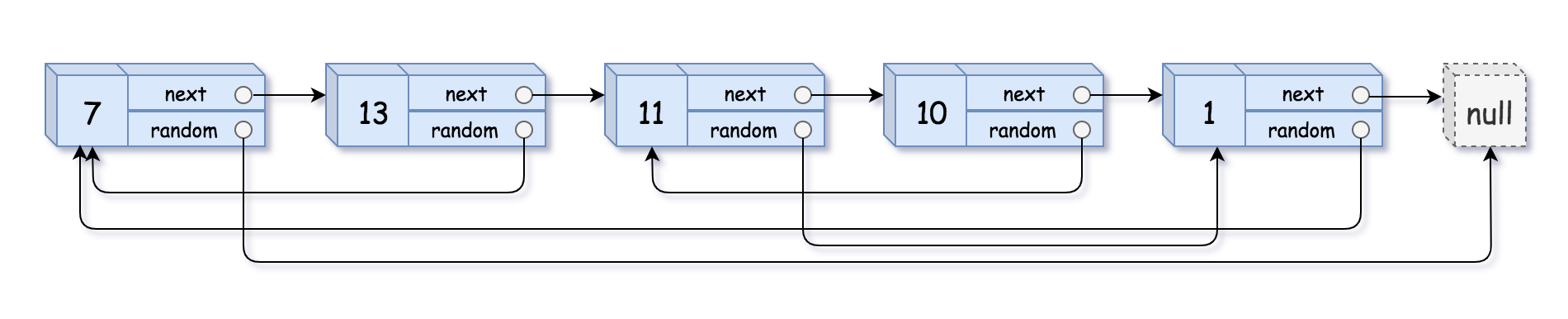


Problem overview
The method copyRandomList receives the head of a singly linked list in which every ListNode has a val, a next link and a random link. The random link points to any node of the same list, or is nil. The method must build a deep copy: exactly as many brand-new nodes as the original, with the same values, where the next and random links of the new nodes point to new nodes only. No link of the copy may lead back into the original list. It returns the head of the copy, or nil for an empty list.
In the first example the nodes, written as [val, random_index], are [7,null], [13,0], [11,4], [10,2] and [1,0]. The copy has the same five values in the same order, and its random links point to the same positions: the second copied node points at the first copied node, the third at the fifth, and so on. The statement asks for O(n) time and allows O(n) extra space.
Approach: a map from each original to its copy
Copying the values and the next chain is easy. The hard part is the random link, which may point forward or backward, so when a copy is created its target may have no copy yet.
The fix is to separate the work into two passes:
- Pass 1: walk the original list and create one new node for each original, holding only the value. Store each pair in a dictionary: original in, copy out.
- Pass 2: walk the original list again. Now every original has a copy, so for each node the dictionary gives the copy of the node, the copy of its successor, and the copy of its random target. Set the copy's
nextandrandomfrom those.
The dictionary needs a key that identifies a node as an object. The value in val is not enough, since the third example has three different nodes that all hold 3. The key must be the identity of the node.
Step by step
- Create the dictionary
copiesof type[ObjectIdentifier: ListNode]. A class instance isn't hashable by default, butObjectIdentifier(obj)wraps its identity in a value that is. Two nodes holding the same value remain separate keys. - Start a walker
var node = head. The head itself stays untouched, since the second pass and the return value need it. - Loop while
node != nil. Inside,nodeis still an optional, and!is safe because the condition just checked it. - Store a new node for the original:
copies[ObjectIdentifier(node!)] = ListNode(node!.val). Only the value is copied here. The links are wired later, when every copy exists. - Advance with
node = node!.next. Without it the loop never ends. - Reset the walker to
headfor the second pass. - Loop again while
node != nil. - Wire
next. The copy ofnodeiscopies[ObjectIdentifier(node!)]!. Itsnextis the copy of the original's successor, ornilwhen there is no successor. A ternary chooses between the two, becauseObjectIdentifiercan't be built from anil. - Wire
randomthe same way, usingnode!.random. - Advance along the original list with
node = node!.next. - Return the copy of the head, or
nilwhenheadisnil. The check comes first, becauseObjectIdentifier(head!)would crash on an empty list.
The solution in Swift
class Solution {
    func copyRandomList(_ head: ListNode?) -> ListNode? {
        var copies = [ObjectIdentifier: ListNode]()
        var node = head
        while node != nil {
            copies[ObjectIdentifier(node!)] = ListNode(node!.val)
            node = node!.next
        }
        node = head
        while node != nil {
            copies[ObjectIdentifier(node!)]!.next = node!.next == nil ? nil : copies[ObjectIdentifier(node!.next!)]
            copies[ObjectIdentifier(node!)]!.random = node!.random == nil ? nil : copies[ObjectIdentifier(node!.random!)]
            node = node!.next
        }
        return head == nil ? nil : copies[ObjectIdentifier(head!)]
    }
}
Swift details worth knowing:
- Why
ObjectIdentifier. Declaring[ListNode: ListNode]doesn't compile for a plain class, because the class doesn't conform toHashable.ObjectIdentifieris hashable and is equal exactly when two references point at the same object. - A dictionary subscript returns an optional.
copies[key]has typeListNode?. The trailing!incopies[ObjectIdentifier(node!)]!is safe, since the first pass stored a copy for every original. For the right-hand sides, the optional is exactly what thenextandrandomproperties accept. - Assigning through a force-unwrap.
copies[...]!.next = ...changes the stored object.ListNodeis a class, so the dictionary holds a reference, and writing through it updates the same object. - The ternary with
nil. Incond ? nil : copies[...], both branches becomeListNode?, which matches the property's type. - The lookup could be shorter. Optional chaining such as
node!.next.flatMap { copies[ObjectIdentifier($0)] }avoids the explicitnilcheck, but the lesson's version is easier to read for a beginner.
Complexity
Time: O(n). Each pass visits every node once, and a dictionary lookup or insertion takes constant time on average.
Space: O(n). The dictionary holds one entry per node, in addition to the n new nodes that the answer needs anyway. The follow-up version of this problem removes the dictionary by interleaving the copies with the originals.
Edge cases and common mistakes
- Empty list. The loops don't run and the last line returns
nil. Writingcopies[ObjectIdentifier(head!)]without thehead == nilcheck would crash. - Equal values.
[3,null],[3,0],[3,null]has three distinct nodes with the same value. Identity keys keep them separate. A value-based key would merge them. - Random pointing to itself. A node whose
randomis the node itself gets a copy whoserandomis the copy itself, because the lookup returns that node's own copy. - Random pointing forward. The second pass handles it, because every copy already exists. A single pass that wires links while copying would not have the target yet.
- Linking to originals. Assigning
node!.randomdirectly to the copy would make the copy point into the original list, which the statement forbids. - Not resetting
node. After the first loop,nodeisnil. Withoutnode = headthe second loop would not run, and no link would be wired.
Testing
[7,null], [13,0], [11,4], [10,2], [1,0]gives a list with the same values and random positions, made of new nodes.[1,1], [2,1]gives the same structure: both random links point at the second node.[3,null], [3,0], [3,null]gives three separate new nodes; only the second has a random link, to the first.- An empty list gives
nil. - A single node
[5,0], whose random points to itself, gives one new node whose random is itself.
