Problem overview
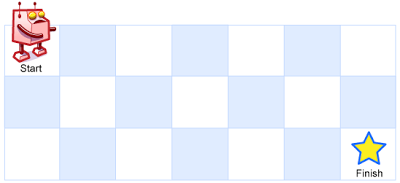
The method uniquePaths(_ grid: [[Int]]) receives a grid of n rows and m columns. A robot starts in the top-left cell and wants to reach the bottom-right cell, moving only down or right. In the grid, 1 marks an obstacle and 0 a free cell. The method returns how many different paths avoid every obstacle. The notes say n and m are at most 100 and the answer fits in 32 bits.
For the 3 by 3 grid with a single obstacle in the middle, the answer is 2: right, right, down, down, or down, down, right, right. Any path through the center is blocked.
Approach: paths into a cell come from two neighbours
Because the robot moves only down or right, the last step into a cell (i, j) came either from the cell above, (i - 1, j), or from the cell to the left, (i, j - 1). Let dp[i][j] be the number of paths from (0, 0) to (i, j). Then, for a free cell,
dp[i][j] = dp[i - 1][j] + dp[i][j - 1]
An obstacle cell has 0 paths, since nothing can stand on it. The first row and first column are special because they have only one neighbour: each cell there can be reached in exactly one way (straight along the edge), unless an obstacle cuts the edge. After an obstacle in the first column, every cell below it is unreachable; the same applies to the first row and the cells to its right.
For the example, the table comes out as:
1 1 1
1 0 1
1 1 2
The center is 0 because of the obstacle, and the bottom-right cell adds the 1 above and the 1 to the left.
Step by step
- Read the dimensions. Store
grid.countinn(rows) andgrid[0].countinm(columns), both withlet. - Create the table as a
var,nrows ofmzeros. - Fill the first column. Loop
iover0..<n. - Stop at an obstacle. If
grid[i][0] == 1,break. Everything below stays 0. - Otherwise set
dp[i][0] = 1: one way to get here, straight down. - Fill the first row the same way, with
jover0..<m. - Stop at an obstacle in the row with
break. - Otherwise set
dp[0][j] = 1. The start cell is written by both loops when it is free, which is harmless. - Fill the rest. Loop
iover1..<nand, inside it,jover1..<m. - Skip obstacles. Only when
grid[i][j] == 0do we compute anything. Obstacle cells keep their 0. - Apply the recurrence: add the cell above and the cell to the left.
- Return
dp[n - 1][m - 1]. If the target itself is an obstacle, it is still 0, which is correct.
The solution in Swift
class Solution {
    func uniquePaths(_ grid: [[Int]]) -> Int {
        let n = grid.count
        let m = grid[0].count
        var dp = [[Int]](repeating: [Int](repeating: 0, count: m), count: n)
        for i in 0..<n {
            if grid[i][0] == 1 {
                break
            }
            dp[i][0] = 1
        }
        for j in 0..<m {
            if grid[0][j] == 1 {
                break
            }
            dp[0][j] = 1
        }
        for i in 1..<n {
            for j in 1..<m {
                if grid[i][j] == 0 {
                    dp[i][j] = dp[i - 1][j] + dp[i][j - 1]
                }
            }
        }
        return dp[n - 1][m - 1]
    }
}
Swift details worth knowing:
- Nested arrays are arrays of values.
gridis a[[Int]]: an array whose elements are arrays.grid[i][j]reads rowiand then elementjof it. The method only readsgrid, so it needs no copy of the input. breakin aforloop. It leaves the innermost loop right away. Since the assignmentdp[i][0] = 1comes after theif, a blocked cell is never written, and noelseis needed.- Ranges at the edges. For a one-row or one-column grid,
1..<nor1..<mis1..<1, an empty range, so the loops are skipped and the first row or column gives the answer. A range whose lower bound is above its upper bound would crash; none can occur here for a non-empty grid. - Empty input.
grid[0]crashes on an empty array, because Swift checks every index. The method assumes at least one row. - Overflow.
Intis 64 bits and an overflowing addition crashes instead of wrapping. With grids of at most 100 by 100 and the notes' promise about the answer, that is not a concern for valid tests.
Complexity
Time: O(n * m). Each cell is computed once with a constant amount of work.
Space: O(n * m). The table has as many cells as the grid. Each row depends only on the row above, so a single row would suffice.
Edge cases and common mistakes
- Obstacle at the start. For
[[1, 0], [0, 0]]the first loop breaks ati = 0, the second atj = 0, the table stays zero and the answer is 0. Paths can't start on an obstacle. - Obstacle at the end. The cell is never filled, so the answer is 0. For
[[0, 0], [0, 1]]the result is 0. - A single free cell.
[[0]]gives 1: the robot is already at the finish. - One row.
[[0, 0, 0]]gives 1, and an obstacle in it makes the answer 0. - Not stopping at an obstacle on the edge. A loop that skips the obstacle but keeps filling would mark cells past it as reachable. For
[[0], [1], [0]]the last cell must be 0, because the obstacle blocks the only route. - Open grid. A 2 by 2 grid without obstacles gives 2.
Testing
[[0, 0, 0], [0, 1, 0], [0, 0, 0]]gives2.[[0, 0], [0, 0]]gives2.[[1, 0], [0, 0]]gives0.[[0, 0], [0, 1]]gives0.[[0]]gives1.[[0], [1], [0]]gives0.
