Understanding the Problem
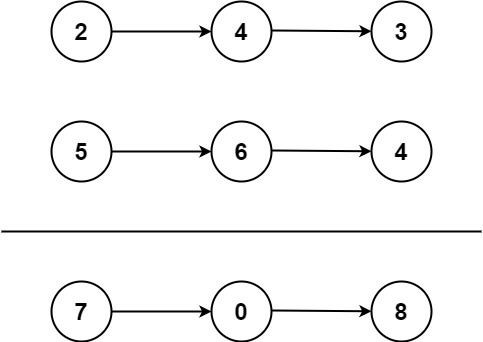
The core challenge of this problem is to handle the addition of two numbers represented as linked lists, where each node contains a single digit and the digits are stored in reverse order. This means the least significant digit comes first. The task is to add these two numbers and return the result as a linked list in the same reverse order format.
This problem is significant in scenarios where numbers are too large to be handled by standard data types, and thus, they are stored in a linked list format. Common applications include arbitrary-precision arithmetic and certain cryptographic algorithms.
Potential pitfalls include handling the carry-over during addition and ensuring that the resulting linked list correctly represents the sum without leading zeros (except for the number 0 itself).
Approach
To solve this problem, we can use a straightforward approach by iterating through both linked lists simultaneously, adding corresponding digits along with any carry from the previous addition. If one list is shorter, we continue with the longer list while considering the carry.
Here is a step-by-step approach:
- Initialize a dummy head for the result linked list and a pointer to traverse it.
- Initialize a variable to store the carry, starting at 0.
- Iterate through both linked lists until both are exhausted and there is no carry left.
- For each pair of nodes (or single node if one list is exhausted), add their values along with the carry.
- Update the carry for the next iteration.
- Create a new node with the digit value of the current sum modulo 10 and append it to the result list.
- Move the pointers of the input lists and the result list to the next nodes.
Algorithm
Let's break down the algorithm step-by-step:
- Initialize a dummy node to act as the head of the result linked list.
- Use a pointer to traverse the result list and a variable to keep track of the carry.
- Loop through the nodes of both input lists until both are null and there is no carry.
- In each iteration, add the values of the current nodes (if they exist) and the carry.
- Compute the new carry and the digit to store in the current node of the result list.
- Move the pointers of the input lists and the result list to their next nodes.
Code Implementation
// Definition for singly-linked list.
class ListNode {
    int val;
    ListNode next;
    ListNode(int x) { val = x; }
}

public class AddTwoNumbers {
    public ListNode addTwoNumbers(ListNode l1, ListNode l2) {
        // Initialize a dummy node to act as the head of the result list
        ListNode dummyHead = new ListNode(0);
        ListNode p = l1, q = l2, current = dummyHead;
        int carry = 0;

        // Loop through both lists until both are null and there is no carry
        while (p != null || q != null) {
            // Get the values of the current nodes, or 0 if the node is null
            int x = (p != null) ? p.val : 0;
            int y = (q != null) ? q.val : 0;

            // Calculate the sum of the values and the carry
            int sum = carry + x + y;

            // Update the carry for the next iteration
            carry = sum / 10;

            // Create a new node with the digit value of the current sum modulo 10
            current.next = new ListNode(sum % 10);

            // Move the current pointer to the next node
            current = current.next;

            // Move the input list pointers to their next nodes if they exist
            if (p != null) p = p.next;
            if (q != null) q = q.next;
        }

        // If there is a carry left, create a new node with the carry value
        if (carry > 0) {
            current.next = new ListNode(carry);
        }

        // Return the result list, starting from the next node of the dummy head
        return dummyHead.next;
    }
}
Complexity Analysis
The time complexity of this approach is O(max(m, n)), where m and n are the lengths of the two input linked lists. This is because we iterate through both lists once. The space complexity is O(max(m, n)) as well, due to the space required for the result linked list.
Edge Cases
Potential edge cases include:
- One or both input lists are empty: The algorithm handles this by treating null nodes as 0.
- The result has an extra carry at the end: The algorithm appends a new node with the carry value if needed.
- Input lists of different lengths: The algorithm continues with the longer list once the shorter list is exhausted.
Examples of edge cases and their expected outputs:
Input: list1 = [0], list2 = [0]
Output: [0]

Input: list1 = [9,9,9], list2 = [1]
Output: [0,0,0,1]
Testing
To test the solution comprehensively, consider a variety of test cases:
- Simple cases with small numbers.
- Cases with different lengths of input lists.
- Cases with carry-over at different positions.
- Edge cases with empty lists or lists with a single node.
Testing frameworks like JUnit can be used to automate the testing process.
Thinking and Problem-Solving Tips
When approaching such problems, consider the following tips:
- Break down the problem into smaller, manageable parts.
- Think about how you would solve the problem manually and translate that into code.
- Consider edge cases and how your solution handles them.
- Practice similar problems to improve your problem-solving skills.
Conclusion
In this blog post, we discussed how to add two numbers represented as linked lists in Java. We covered the problem definition, approach, algorithm, code implementation, complexity analysis, edge cases, and testing. Understanding and solving such problems is crucial for developing strong problem-solving skills and preparing for technical interviews.
We encourage you to practice and explore further to solidify your understanding.
Additional Resources
For further reading and practice problems, consider the following resources: